
UK Workplace Exposure Limits Explained
Read More

A dissolved oxygen meter is a specialist instrument designed to measure the amount of gaseous oxygen dissolved within a liquid. It is a vital tool used everywhere from environmental science labs to high-tech manufacturing plants, helping teams ensure water quality, fine-tune process efficiency, and meet strict regulatory standards. The data it provides is critical for everything from protecting aquatic ecosystems to preventing catastrophic industrial equipment failure.
At its heart, a dissolved oxygen (DO) meter works like a health monitor for water. Just as we need oxygen in the air to breathe, countless biological and chemical processes rely on a specific amount of oxygen being present in water. Too little or too much can have huge consequences, making an accurate measurement absolutely essential.
This measurement is crucial for maintaining the delicate balance needed in so many applications. Think of it as managing a key ingredient in a complex recipe; the right amount ensures success, while the wrong amount can spoil the entire batch. This is exactly why a dependable dissolved oxygen meter is so indispensable.
The applications for dissolved oxygen measurement are incredibly diverse, but they all share one common need: precision and control. From natural rivers and lakes to highly controlled industrial environments, the concentration of DO is a key indicator of health and performance.
Here are a few key areas where DO measurement is critical:
In the UK, dissolved oxygen meters are indispensable for complying with regulations like the Water Framework Directive. The data paints a clear picture: in 2022, a staggering 85% of monitored river sites failed to achieve good ecological status. Low DO levels were a primary factor in 42% of these cases.
This has spurred major investment in monitoring equipment. DO meters play a key role in balancing regulatory demands with operational efficiency. For example, Thames Water used advanced meters to cut its aeration energy costs by 22%, all while boosting its DO compliance from 67% to an impressive 94%. You can explore more data on the dissolved oxygen sensor market to understand its growing importance.
At the heart of every dissolved oxygen meter lies the sensor, the piece of equipment doing the real work of detecting oxygen molecules in a liquid. While the goal is always the same—getting an accurate measurement—the two main technologies used to get there are worlds apart. Nailing down these differences is the first step to choosing the right instrument for your needs.
The two players in this space are optical and electrochemical sensors. Each works on a completely different principle, which in turn dictates its strengths, weaknesses, and where it truly shines. To make the right call, you have to look past the meter’s casing and understand the engine running inside.
A dissolved oxygen meter is not just a measurement device but a central tool for monitoring, protecting, and optimising a whole range of processes.
A DO meter’s role often extends far beyond simple measurement, branching into active process control and even asset protection.
An optical DO sensor uses a clever trick involving light and a special dye. Picture a tiny spotlight pointed at a film that glows when a blue light hits it. When oxygen molecules in the water bump into this film, they effectively “quench” or dampen its glow.
The sensor measures both the intensity and the lifetime of the light that bounces back from this glowing film. The more dissolved oxygen there is, the more that glow is suppressed. By precisely measuring this change, the meter calculates the dissolved oxygen concentration with impressive accuracy.
This method is a firm favourite for its stability and low-maintenance nature. Crucially, it does not consume oxygen during the measurement. This means it gives reliable readings even in still water, a huge advantage in many field applications where stirring is not an option.
Electrochemical sensors are the old guard, operating more like a miniature battery that generates an electrical current. These sensors come in two flavours: galvanic and polarographic. Both rely on a chemical reaction to measure oxygen, but they get there in slightly different ways.
Inside the sensor, oxygen molecules diffuse through a thin, permeable membrane and take part in a chemical reaction at an electrode. This reaction produces a tiny electrical current that is directly proportional to the amount of dissolved oxygen in your sample. The meter simply measures this current and translates it into a DO reading.
While it is a long-established technology for dissolved oxygen, the principles are shared across other gas measurement tools. You can get a sense of this by reading about the difference between Zirconia and electrochemical oxygen gas sensors, which shows just how versatile these electrochemical principles are.
So, which one is for you? The choice between optical and electrochemical sensors really comes down to your specific application and what you prioritise in terms of maintenance, cost, and performance. An optical sensor, for example, typically needs calibrating far less frequently and has no messy electrolyte solution to top up.
On the other hand, its sensor cap has a limited lifespan and will need replacing every one to two years. Electrochemical sensors demand a bit more hands-on attention, like regularly replacing the membrane and electrolyte solution.
To make it clearer, here is a side-by-side comparison of their key features.
| Feature | Optical (Luminescent) Sensor | Electrochemical Sensor |
|---|---|---|
| Response Time | Slower, often around 40 seconds | Faster, typically around 20 seconds |
| Maintenance | Lower; annual cap replacement | Higher; regular membrane and electrolyte changes |
| Calibration | Highly stable, holds for months | Requires more frequent calibration |
| Flow Dependence | No flow or stirring required | Requires sample movement for accuracy |
| Initial Cost | Generally higher | Generally lower |
Ultimately, the best sensor is the one that fits seamlessly into your workflow. For low-maintenance, long-term deployments, optical is often the winner. But for applications needing a faster response and where budget is a primary concern, the tried-and-tested electrochemical sensor still holds its own.
Choosing the right dissolved oxygen meter often starts with a trip through its technical data sheet, which can feel like trying to read another language. But understanding these specs is the secret to matching an instrument to your precise needs. Once you can break down the essential terms, you will be able to compare models confidently and pick a meter that delivers the reliability your work demands.
Think of a data sheet as the meter’s CV. It tells you exactly what the instrument is capable of, from its measurement limits to how quickly it responds. Let us translate some of the most critical specifications you will come across.
When you first glance at a spec sheet, three values usually jump out as the main indicators of a meter’s performance. They tell you the boundaries of its measurement capabilities and, just as importantly, how trustworthy its readings are.
One of the most crucial features you will see listed is Automatic Temperature Compensation (ATC). This is not just a convenient extra; it is fundamental to getting an accurate dissolved oxygen measurement. The reason comes down to simple physics: cold water can hold more dissolved oxygen than warm water.
Think about a glass of fizzy drink. When it is ice-cold, it holds its fizz (dissolved gas) for ages. But leave it out on a warm day, and the bubbles escape much more quickly. Water behaves in exactly the same way with oxygen.
A dissolved oxygen meter without ATC is like a car speedometer that does not account for tyre size—the number on the dial might look right, but it is not reflecting reality. Without correcting for temperature, a reading could be wildly inaccurate, leading to flawed data and poor process control.
ATC uses a built-in temperature sensor to automatically adjust the DO reading, giving you the true concentration for that specific temperature. It takes the guesswork and manual correction charts out of the equation, ensuring your data is reliable even when conditions are changing.
In certain environments, factors other than temperature can throw your dissolved oxygen readings off. For these specialised applications, meters with additional compensation features are an absolute must.
Two key ones to look for are:
Connecting the technical specs of a dissolved oxygen meter to real-world industrial demands is where theory hits the factory floor. Picking the right instrument is not just about the latest technology; it is about finding the one that solves your specific problems, whether that is preventing costly corrosion or slashing your energy bills.
Different industries are completely different worlds. Think about the high temperatures of metal treatment versus the biologically sensitive conditions of a wastewater plant. Each scenario calls for a unique set of features and sensor capabilities, so an application-first approach is the best way to figure out which DO meter is the right tool for the job.
In both heat treatment and advanced additive manufacturing, managing the quality of cooling water is absolutely fundamental to protecting your assets. In these high-temperature environments, the main enemy is corrosion. It can quickly degrade expensive equipment, leading to frustrating downtime and massive repair bills.
Dissolved oxygen is a primary catalyst for corrosion in water-based cooling circuits. By constantly keeping an eye on DO levels with a reliable meter, operators can be proactive about maintaining water chemistry. This ensures the longevity and performance of critical parts like quench tanks, heat exchangers, and the tiny cooling channels inside 3D printing systems.
For these jobs, you need a robust dissolved oxygen meter with a sensor that can take a beating. Since these are often stable, closed-loop systems, an optical sensor is an excellent choice. Its low maintenance needs and long-term stability mean you can essentially install it and forget it, trusting it to provide consistent data without constant tinkering. It fits perfectly into any preventive maintenance plan.
The booming hydrogen production sector, especially green hydrogen made via electrolysis, has extreme demands when it comes to water purity. The efficiency and safety of an electrolyser are directly tied to the quality of its deionised water. Even tiny amounts of dissolved oxygen can introduce risks and drag down the system’s overall performance.
Here, a dissolved oxygen meter acts as a critical quality control gatekeeper. It provides that final check, confirming the feed water is properly de-aerated before it enters the electrolyser stack. Keeping DO levels near zero is vital for getting the most life out of the catalyst materials and making sure the process runs at peak efficiency.
Because you need incredible precision at very low concentrations, the choice of meter is critical. You will want an instrument with high accuracy and resolution in the low parts-per-billion (ppb) range. Specialised electrochemical sensors designed for high-purity water often win out here, providing the fast response and sensitivity needed to catch any deviation from strict quality standards instantly.
In processes where purity is everything, your measurement instrument is your first line of defence. The right dissolved oxygen meter does not just measure a parameter; it validates the integrity of your entire production process, from feed water to final product.
In wastewater treatment plants, dissolved oxygen is the absolute cornerstone of the secondary treatment stage, where microorganisms get to work breaking down organic contaminants. The entire process depends on maintaining the perfect DO balance to keep these helpful bacteria healthy and active. The problem? Aeration is one of the most energy-hungry parts of wastewater treatment, often accounting for a huge chunk of a plant’s electricity costs.
This creates a constant balancing act. Too little oxygen, and the biological treatment process sputters, failing to meet environmental discharge rules. Too much, and you are just burning money by running the blowers for no good reason.
A dissolved oxygen meter gives operators the precise control needed to get this process just right. By providing real-time data, it allows automated systems to adjust aeration levels on the fly, supplying just enough oxygen to meet biological demand. This ensures you stay compliant with regulations while drastically cutting energy consumption. For more insights on water technology across different industries, the articles on the WaterTechIntel Blog are a great resource.
The harsh, variable conditions of a wastewater basin demand a specific type of sensor. An optical DO sensor is usually the top choice here because of its resilience. It is not bothered by fouling in the same way an electrochemical sensor is, and it does not need flow or stirring to work properly, making it perfect for the turbulent environment of an aeration tank. Its stability also means less frequent calibration—a massive plus in a large-scale, 24/7 facility.
A dissolved oxygen meter is only as good as its last calibration. Think of it this way: an uncalibrated instrument is just a random number generator, churning out data that could lead to costly errors in your industrial processes or completely flawed environmental conclusions. Mastering a consistent calibration and maintenance routine is the single most important thing you can do to ensure your meter delivers accurate, reliable, and trustworthy results, every single time.
This is not just about ticking boxes for quality control; it is about having complete confidence in your data. Proper upkeep transforms your dissolved oxygen meter from a simple tool into a precision instrument that protects your equipment, optimises your processes, and ensures you meet your compliance goals.
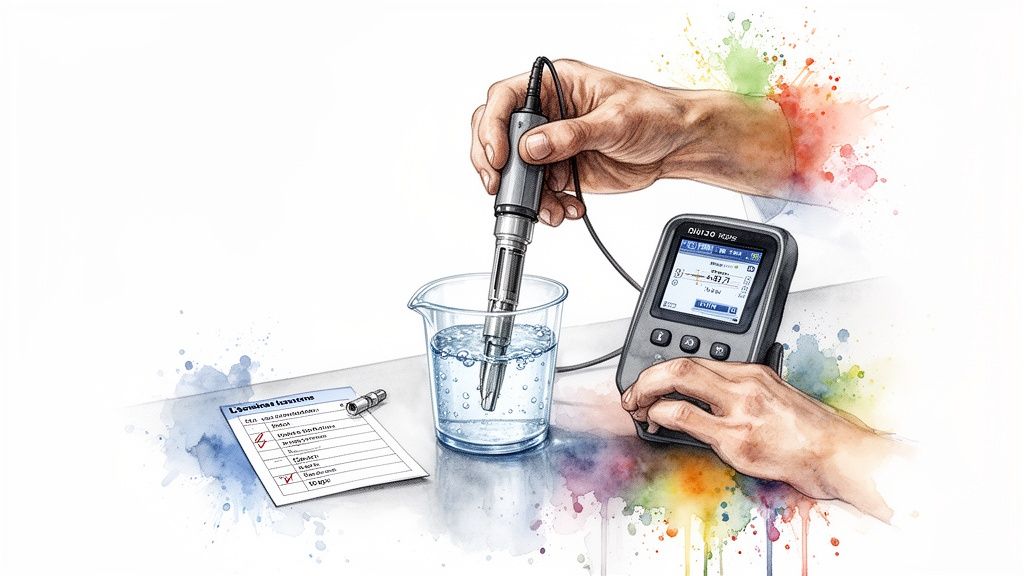
Accurate DO calibration comes down to setting two crucial reference points, which allows the meter to create a reliable measurement scale. It is a bit like tuning a guitar; you need to get the high and low notes right before you can play a melody. For a dissolved oxygen meter, these two points are the zero point and the 100% saturation point.
First, you establish a true zero reading. This confirms the sensor does not detect oxygen when none is present. This is usually done using a special zero-oxygen solution, like sodium sulphite, which chemically scrubs all the oxygen out of the water.
Second, you set the upper limit. This is typically done in water-saturated air, as the air provides a consistent and known oxygen concentration of 20.9%. By exposing the sensor to this environment, the meter learns what a 100% air saturation level looks like, anchoring the top of its measurement scale.
Routine maintenance is the secret to extending the life of your dissolved oxygen meter and heading off the most common measurement problems. By building these simple tasks into your workflow, you can catch potential issues long before they escalate. For a deeper dive into why this process is so vital, our guide explaining why calibration is key offers further insights.
Here is a practical checklist to follow:
A well-maintained sensor is a reliable sensor. Spending just five minutes on these checks after use can save you hours of troubleshooting down the line and dramatically improve the performance and lifespan of your equipment.
Even with perfect maintenance, you might occasionally run into problems. Knowing how to quickly diagnose and fix them is an essential skill for any operator.
In many advanced industrial processes, measuring dissolved oxygen is just one vital piece of a much larger analytical puzzle. A standalone reading is useful, but its true power is unlocked when a dissolved oxygen meter is integrated into a complete gas analysis workflow. This transforms it from a simple measurement device into an active component of a unified process control strategy.
This integration lets you see the bigger picture. Instead of just knowing the DO level, you can correlate it with other critical gas measurements, leading to smarter, more efficient operational decisions. A holistic view is always more powerful than an isolated data point.
The practical side of this integration relies on standardised communication protocols that allow different pieces of equipment to speak the same language. Data from a dissolved oxygen meter sensor needs to be transmitted reliably to a central control system, a programmable logic controller (PLC), or a multi-gas analyser.
Two of the most common and robust protocols for this task are:
These protocols ensure that the data from your dissolved oxygen meter is seamlessly fed into the brain of your operation, making it an active participant in process automation.
Combining DO data with other gas measurements provides a far richer understanding of your process. This unified approach is essential in complex applications where multiple variables influence one another, ensuring both efficiency and safety are maintained.
Consider a biogas facility, a prime example of where this synergy shines. Operators need to monitor both methane (CH₄) production and any potential oxygen ingress.
By integrating a dissolved oxygen meter with a methane analyser, the facility gains a comprehensive view. High methane readings are a sign of good production, but if DO levels suddenly spike, it could indicate an air leak—a critical safety risk in a methane-rich environment.
This combined data allows for immediate, informed action.
The goal is to manage all your critical process variables in one place for streamlined decision-making. This is where a central multi-gas analyser or a multiplex sampling system becomes invaluable. Instead of checking multiple screens or data logs, all information is consolidated onto a single platform.
For complex setups with multiple sampling points, a system that can intelligently switch between different gas streams is essential. Modern solutions, like the new Rapidox R2112 multiplex sampling system, are designed precisely for this purpose. They can pull data from a dissolved oxygen meter in one line and a nitrogen analyser in another, presenting a complete operational dashboard.
This unified strategy does not just simplify monitoring; it enhances your ability to spot trends, troubleshoot issues, and optimise your entire process with greater precision and confidence.
Even with the fundamentals down, it is the real-world situations that often bring up the trickiest questions. When you are out in the field or back in the lab with your new DO meter, practical queries are bound to pop up.
This section tackles some of the most common questions we hear, from calibration routines to sensor maintenance. Think of it as a practical guide to getting the most from your instrument with confidence.
There is no one-size-fits-all answer here—the right calibration frequency really depends on your application’s demands and the type of sensor you are using. The key is to match your schedule to your needs.
For critical process control in an industrial setting, where every percentage point matters, daily or even per-shift calibration checks are common practice. On the other hand, if you are doing general environmental monitoring where conditions are less intense, a weekly calibration might be perfectly adequate to keep your data reliable.
A great rule of thumb is to start with the manufacturer’s recommendation. From there, you can adjust the schedule based on your own observations of the instrument’s performance and the specific requirements of your work.
Technically, yes, you can use a dissolved oxygen meter in other liquids, but it comes with a major caveat. These instruments are designed, built, and calibrated to work specifically in water-based (aqueous) solutions.
Oxygen behaves very differently when it dissolves in other liquids, like oils or solvents. Using a standard DO meter in these substances means any reading you get will not be accurate without applying special correction factors. It is vital to consult the manufacturer for guidance on any non-aqueous applications to avoid generating misleading data.
When it comes to maintenance, the biggest difference between optical and electrochemical sensors boils down to what you need to replace and how often you need to do it. Each has its own consumable parts that wear out over time.
For robust and precise gas analysis solutions, including our versatile range of OEM systems, trust the experts at Cambridge Sensotec. Learn more about how our instruments can support your application at https://cambridge-sensotec.co.uk.
Please leave your email address below and we'll reach out promptly.