Hydropower advantages and disadvantages: A Clear Guide to Sustainable Power
Read More
Hydropower is a fascinating paradox. It is a clean, powerful, and reliable source of renewable energy, yet its benefits come at a cost—often a steep one involving significant environmental change and massive upfront investment. The core debate is a balancing act between its clean energy credentials and long-lasting infrastructure versus the damage to ecosystems and the limited number of places it can actually be built. This trade-off sits at the heart of discussions about one of the world's oldest and most proven green technologies.
Hydropower is an absolute giant in the renewable energy world, generating around 16% of global electricity. The concept is brilliantly simple: it converts the kinetic energy of flowing water into electrical power. You can think of a hydroelectric dam as a colossal, highly controlled waterfall. By managing a river's flow, we turn its immense natural force into a steady, predictable supply of power that has been lighting up communities for over a century.
However, the conversation around hydropower is never simple. On one hand, you have a clean, emissions-free power source that, once constructed, can run for 50 to 100 years with incredibly low running costs. Unlike solar or wind, it is not at the mercy of the weather, providing a stable backbone for entire national grids.
On the other hand, the impact of building these structures is impossible to ignore. Constructing a large dam fundamentally and permanently alters a river's ecosystem. This reality forces a difficult choice between securing clean energy for millions and preserving vital natural habitats.
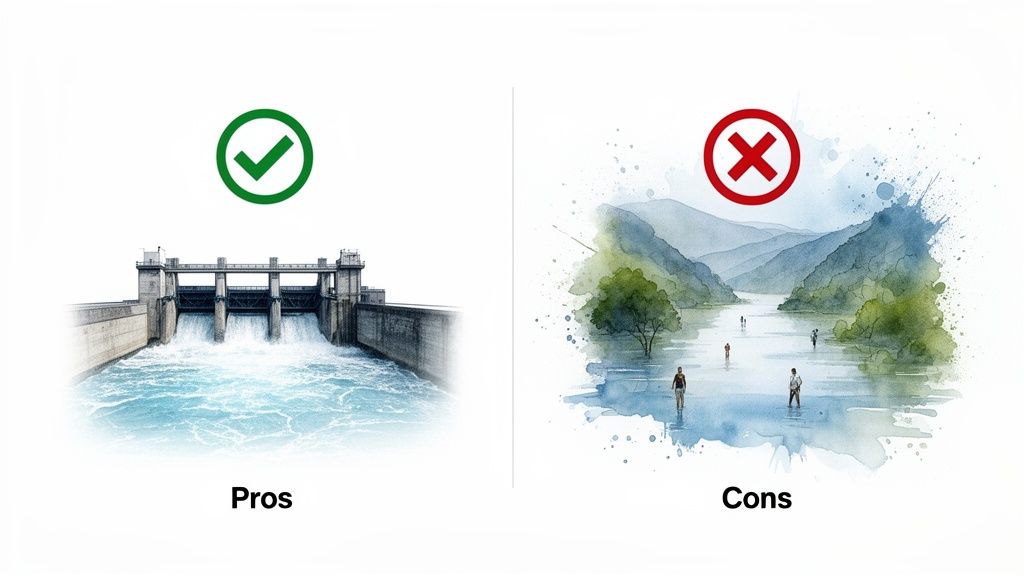
To truly grasp the debate, it helps to see the main arguments side-by-side. Deciding to build a hydropower plant means weighing long-term energy security against immediate environmental and financial hurdles. This table breaks down the essentials.
| Advantages | Disadvantages |
|---|---|
| Renewable and Clean – Produces no emissions during operation. | High Upfront Costs – Building dams requires massive investment. |
| Highly Reliable – Generates power 24/7, unlike solar or wind. | Environmental Impact – Alters river ecosystems and harms wildlife. |
| Low Operating Costs – Minimal expenses after construction. | Displaces Communities – Reservoirs can flood homes and towns. |
| Long Lifespan – Plants can operate for over a century. | Location Dependent – Requires specific geography and water flow. |
| Flexible and Dispatchable – Output can be adjusted to meet demand. | Risk of Drought – Low water levels can reduce power generation. |
This at-a-glance summary highlights the core dilemma. While the promise of low running costs makes hydropower economically tempting for the long haul, the environmental disruption poses serious ethical and ecological questions that cannot be brushed aside.
The central dilemma of hydropower is clear: it offers one of the most reliable forms of clean energy available but at a significant environmental and social cost.
The points in this table are just the beginning. Each one carries enormous weight, and in the following sections, we will dive deeper into the details, giving you the context needed to build a complete picture of this powerful but polarising energy source.
Hydropower stands as a true heavyweight in the world of renewable energy, largely thanks to its remarkable consistency and clean operational profile. Unlike wind or solar, which are entirely dependent on the weather, hydropower provides a constant, reliable 24/7 output. This unwavering stability makes it a foundational, baseline power source for national grids.
Once a hydropower plant is up and running, it produces virtually no greenhouse gas emissions. The process itself—the simple act of water turning turbines—is clean. This is a stark contrast to fossil fuels, which pump harmful pollutants into the atmosphere throughout their operational life.
On top of that, hydropower’s efficiency is in a class of its own. Modern hydroelectric plants can convert up to 90% of the water's available energy into electricity. This puts other energy sources in the shade, including solar panels (around 20-25% efficient) and even traditional coal plants (33-40% efficient).
One of the most compelling arguments for hydropower is its extraordinary longevity and low running costs. The initial construction of a dam is undeniably a massive financial undertaking, but this investment pays dividends over an exceptionally long lifespan.
Many hydropower stations built over a century ago are still in service today—a real testament to their robust engineering. With proper maintenance, these facilities can reliably generate power for multiple generations, spreading that initial cost over an incredibly long period.
After construction, the day-to-day operational costs are minimal. The 'fuel'—water—is free and naturally replenished by the water cycle. This insulates electricity prices from the volatile international markets for gas, oil, and coal, providing long-term economic stability and predictable energy costs for everyone.
Hydropower's greatest economic strength lies in its combination of an incredibly long operational life and near-zero fuel costs, creating a predictable and affordable energy source for decades.
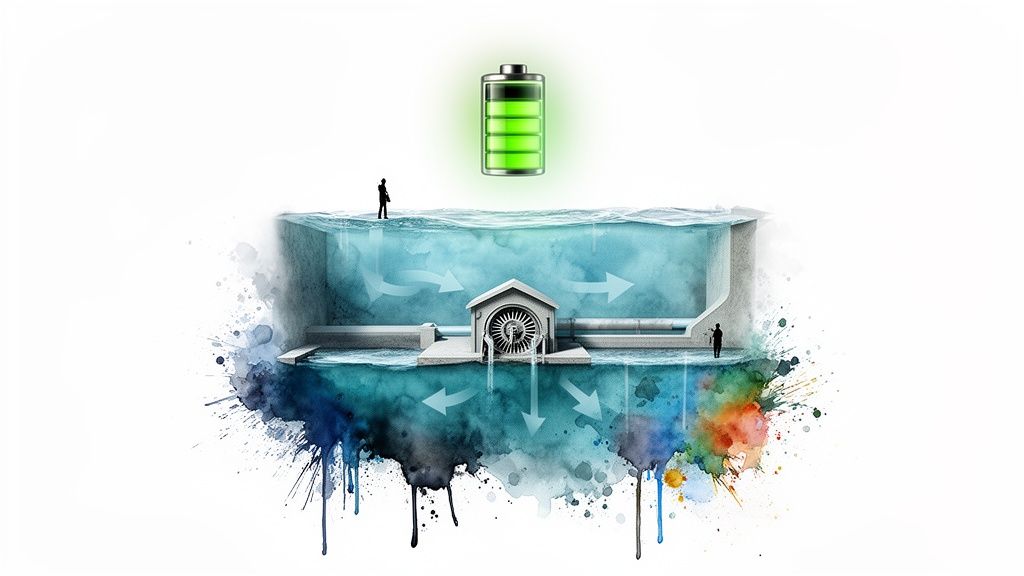
Beyond generating baseline power, hydropower plays a crucial, dynamic role in grid management, particularly through a technology called pumped-storage hydro. Think of these facilities as giant, rechargeable water batteries that are essential for balancing electricity supply and demand across the country.
Here's how this 'water battery' works:
This ability to respond in seconds makes pumped storage vital for preventing blackouts and stabilising the grid. As the UK integrates more intermittent renewables like wind and solar, these water batteries become even more important for storing surplus energy and releasing it when needed. Schemes in Scotland, for example, are central to managing the UK's power supply.
As of 2018, the UK had 1.87 GW of installed capacity from conventional hydroelectric stations, representing 4.2% of its renewable energy capacity. A striking real-world example of its importance occurred on 9 January 2022. At 4 am, hydropower supplied 333 MW. Just an hour later, grid demand spiked by exactly 333 MW; without that hydropower buffer, electricity prices could have soared, demonstrating its power to save consumers significantly during energy crises. You can learn more about the UK's hydroelectricity landscape and its impact on Wikipedia.
While hydropower offers clean and reliable energy, it is far from a perfect solution. Its advantages come with serious trade-offs, and the most significant is its profound impact on the environment. Building a large dam is one of the most drastic ways humans can alter a landscape, and the consequences ripple through entire ecosystems.
The most immediate effect is on the river itself. A dam acts as a massive barrier, fundamentally changing a dynamic, flowing river into a static, lake-like reservoir. This process drastically alters water temperature, chemistry, and oxygen levels, creating an environment that is often inhospitable to the native aquatic life that evolved to live in a free-flowing river.
These structures also physically block the migration routes of fish. Species like salmon and sturgeon, which travel upstream to spawn, find their paths completely cut off. While solutions like 'fish ladders' have been designed to help, their effectiveness is often limited, and populations can decline sharply, disrupting the entire food web.
Creating a reservoir behind a dam means flooding vast areas of land. This has two major negative outcomes: the destruction of terrestrial habitats and the displacement of human communities. Forests, wetlands, and fertile valleys are submerged, erasing valuable ecosystems that supported diverse wildlife.
This loss of land also carries a heavy social cost.
The construction of a single project, the Three Gorges Dam in China, displaced an estimated 1.3 million people, submerging entire towns and cities and forcing communities to abandon their ancestral homes.
This is a recurring story in the history of large-scale hydropower. While people are often compensated, no amount of money can replace lost cultural heritage and community bonds. This human element is a critical, and often heartbreaking, factor in the debate over hydropower.
Beyond the environmental and social toll, hydropower faces significant economic and operational hurdles. The upfront capital required to build a large dam is immense, often running into the billions of pounds. These are not projects undertaken lightly, requiring decades of planning and construction.
Once operational, the risks do not disappear. Although modern dams are built to incredibly high safety standards, the potential for catastrophic failure, however small, always exists. The collapse of the Banqiao Dam in China in 1975 led to an estimated 171,000 deaths, a stark reminder of the destructive power held back by these structures.
Furthermore, as global climate patterns shift, hydropower facilities face a growing threat from droughts, which can severely reduce water levels and cripple their ability to generate power. Monitoring the complex systems within these facilities is crucial for maintaining both efficiency and safety. You can learn more by exploring how gas analyser solutions are used in monitoring emissions from renewable energy.
Beyond the initial construction hurdles, hydropower offers a remarkably stable and predictable economic future—acting as a crucial shield against volatile global energy markets. Once a plant is operational, its fuel is simply flowing water, which comes at no cost. This fundamental advantage insulates the UK from the unpredictable price swings of international gas and oil, providing long-term cost certainty for both households and industries.
This stability is not just theoretical; it translates into tangible savings and economic resilience. Hydropower’s low operational and maintenance costs mean that electricity can be generated at a consistent, affordable rate for decades. This creates a reliable foundation for the national economy, helping to keep energy bills down and manufacturing costs predictable. In a turbulent world, that is a significant competitive advantage.
What is more, these facilities are built to last. With lifespans often exceeding a century, the initial investment is spread over generations, delivering a continuous return in the form of clean, low-cost power long after the construction loans have been repaid.
The economic benefits of hydropower extend far beyond the energy bill. The sector is a vital source of sustained employment, particularly in rural regions where skilled jobs can be scarce. The construction phase of new projects or the refurbishment of older plants requires a large workforce of engineers, construction workers, and technical specialists.
Once operational, these facilities continue to support high-quality, long-term careers in operations, maintenance, and management. This is especially true in areas like the Scottish Highlands, where hydropower is not just a power source but an integral part of the local economy.
These jobs create a positive ripple effect, supporting local businesses, supply chains, and community services. This boosts regional economies and helps to ensure that the transition to renewable energy benefits all parts of the UK, not just its urban centres.
Hydropower's role becomes crystal clear during energy crises. A 2022 analysis highlighted its importance in supporting strategic goals while slashing bills. The UK's non-pumped capacity is around 2 GW, with the potential to expand to 3 GW.
A powerful example came in January 2022, when just 333 MW from hydro at 4 am prevented a potential price spike to £99.90/MWh, saving millions across the grid. Annually, conventional and run-of-river schemes generate about 5,000 GWh, supporting jobs and aligning with government policies to reduce consumer prices, especially in Scotland where most capacity is located. You can explore the full economic analysis of UK hydropower to see the detailed findings.
Hydropower provides a powerful economic buffer, protecting consumers and industry from the price shocks of fossil fuels while simultaneously fuelling regional job growth.
Despite these advantages, securing funding for new large-scale hydro projects presents a significant challenge. The immense upfront capital required can be a major hurdle, and investors often look for quicker returns than the long-term payback period offered by hydropower.
Government incentives, such as contracts-for-difference (CfDs) and other support mechanisms, are therefore essential to de-risk these investments and attract the necessary private capital. Creating a stable and supportive policy environment is key to unlocking the next generation of hydropower projects, particularly in pumped storage, which is vital for grid stability.
Effective management of these complex energy systems, including monitoring for efficiency and safety, is also a critical part of ensuring their long-term value. For those interested in the technical side, you can learn more about the role of gas analysis in power generation. Ultimately, building investor confidence through clear policy and proven operational excellence is the final piece of the economic puzzle for UK hydropower.
Not all hydropower is created equal. To really get a handle on its potential and its pitfalls, we need to look past the classic image of a single, colossal dam. The industry actually uses several distinct approaches to generate power from water, each designed for different geographies and grid demands.
The three main types of hydropower facilities are Impoundment, Diversion, and Pumped Storage. You can think of these as different tools in an engineer’s toolkit. One is a sledgehammer for large-scale, constant power; another is a precision scalpel for minimal environmental impact; and the third is a versatile wrench for balancing the entire energy system. Each has a specific role to play.
Understanding these differences is crucial because the choice of technology directly shapes a project's cost, environmental footprint, and operational flexibility. Let's break down how each one works.
When most people think of hydropower, they are picturing an impoundment facility. This is the traditional large dam that blocks a river, creating a vast reservoir behind it. Water is then released through turbines, which spin to generate electricity.
This method is the most common for large-scale hydropower generation.
The infographic below shows how the UK hydropower economy, largely built on this reliable model, helps to shield markets, create jobs, and save consumers money.
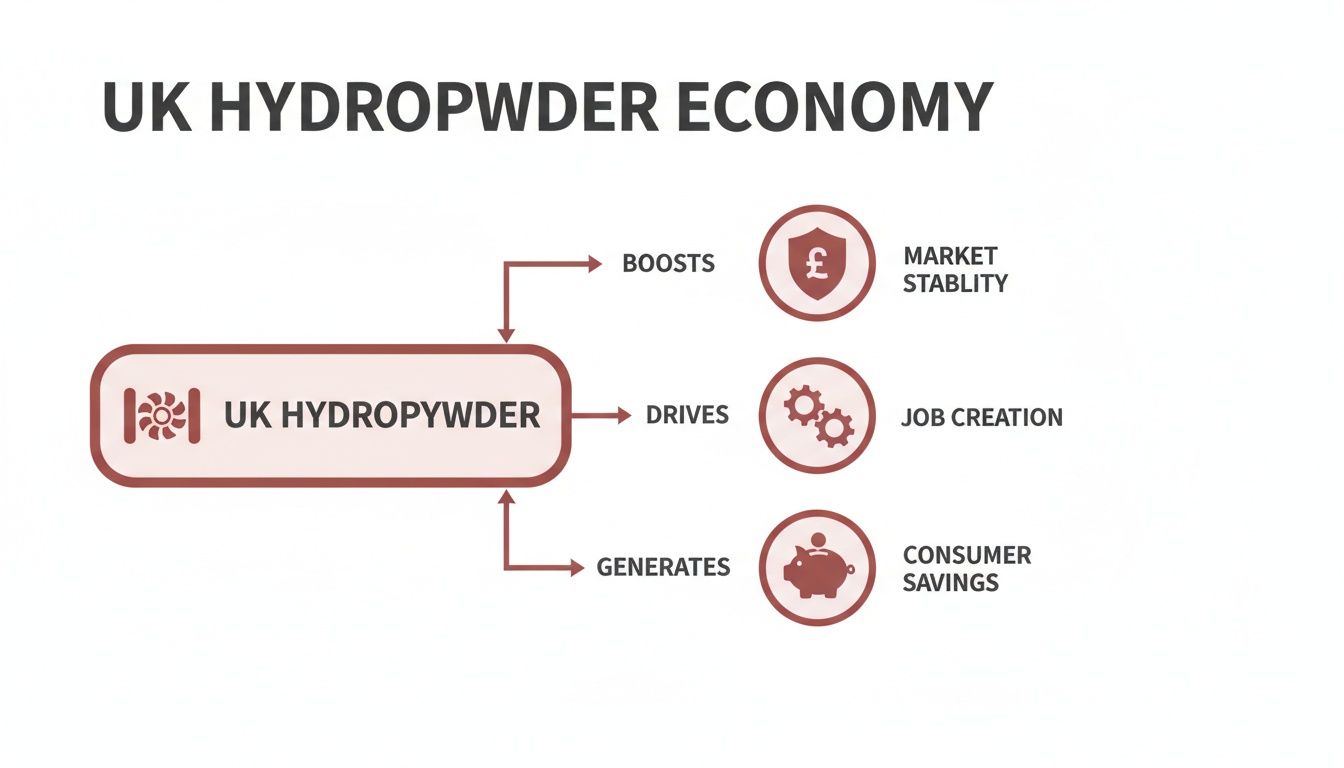
This visualisation illustrates how stable hydropower provides a market shield against volatile fuel prices, stimulates job creation, and leads to direct savings for households and businesses.
A diversion, or 'run-of-river', system takes a different tack. Instead of stopping a river with a massive dam, it simply channels a portion of the river's flow through a canal or penstock to a turbine. The water is then returned to the river downstream.
Run-of-river hydropower offers a lighter environmental touch. By working with the river's natural flow rather than fundamentally altering it, these systems minimise the ecological disruption associated with large reservoirs.
This design significantly reduces the project's physical and ecological footprint.
Pumped storage hydropower is not really about generating new energy from scratch; it is about storing it. It acts like a massive, rechargeable water battery for the national grid. These facilities have two reservoirs, one high and one low.
When electricity demand is low and there is surplus power on the grid (like on a windy night), they use cheap electricity to pump water from the lower reservoir up to the top one. Then, when demand spikes, the water is released back down through turbines to generate electricity almost instantly.
Looking ahead, hydropower is set to play a specialised yet vital role in Britain's journey towards Net Zero. The days of building vast new dams across the UK's rivers are mostly behind us, but that does not mean hydro's story is over. Far from it. The focus is now shifting towards smarter, more flexible ways of using this century-old technology.
The main area for growth is not in massive new river-blocking projects, but in upgrading and optimising what we already have. Many of the UK’s hydro plants have been running for decades. By retrofitting them with modern, more efficient turbines and digital control systems, we can squeeze a lot more clean energy from the very same water resources.
At the same time, there is a growing interest in smaller, low-impact schemes. These 'run-of-river' projects and micro-hydro installations can be developed with a much lighter environmental touch, providing clean, localised power without needing large, disruptive reservoirs.
Perhaps the most important job for hydropower in a green future is acting as the grid's essential partner to wind and solar. Pumped-storage hydro facilities are effectively the UK's 'giant water batteries', and they will only become more critical as we rely more on intermittent renewables. They provide the large-scale, long-duration energy storage we need to keep the lights on when the wind is not blowing or the sun is not shining.
As the UK builds more wind and solar capacity, pumped-storage hydro will be the critical balancing mechanism that ensures grid stability, storing surplus green energy and releasing it in seconds to meet demand.
Of course, this future is not without its hurdles. Regulatory frameworks need to adapt to support new pumped-storage projects, which require huge investment and long-term planning. For organisations looking to get involved, exploring various renewable energy grants can provide the essential financial backing for these capital-intensive schemes.
Public perception is another key factor. We need clear communication to explain the difference between new-build storage projects and the traditional, ecologically disruptive dams of the past.
Climate change also presents a very real threat. Shifting rainfall patterns and more frequent droughts could affect water availability, making careful resource management more important than ever. Innovations in weather forecasting and water management will be essential to keep hydropower a reliable asset. As we innovate, it is also smart to explore complementary technologies. You might be interested in learning more about the potential of green hydrogen as a clean energy carrier in our related guide.
This section breaks down some of the most common questions about hydropower, giving you straightforward answers to clarify key debates.
Hydropower is certainly classed as a renewable energy source because it runs on the natural water cycle and does not produce greenhouse gases during operation. However, whether it is truly ‘green’ is a hot topic, largely due to the significant environmental footprint of large-scale dams.
When a massive reservoir is built, it can flood huge areas of land, wiping out habitats, completely changing river ecosystems, and blocking vital fish migration routes. So, while it is a world away from the pollution of fossil fuels, it is a clear trade-off: clean air versus the health of our river systems.
The biggest edge hydropower has over solar and wind is its reliability and dispatchability. Hydro plants can generate electricity 24/7 and can be ramped up or down in minutes to meet grid demand, which makes them absolutely vital for keeping the lights on.
Solar and wind, on the other hand, are intermittent—they only work when the sun is shining or the wind is blowing. That said, solar and wind projects are generally cheaper and much quicker to build, and their local environmental impact is less disruptive than a major dam project.
Think of pumped-storage hydro as the perfect partner for intermittent renewables. It acts like a giant, grid-scale battery, storing surplus wind and solar energy for when it is needed most.
Exceptional longevity is one of hydropower’s greatest economic strengths. It is not uncommon to find plants built in the early 20th century that are still running efficiently today.
With proper maintenance and occasional upgrades to key components like turbines and generators, a hydropower facility can easily last for 50 to 100 years, and often much longer. This incredible durability is what helps justify the high upfront construction costs, as the plant can deliver low-cost, reliable power for generations.
The era of building massive new dams across the UK is pretty much over, mainly due to environmental regulations and the fact that most of the best locations are already taken. But that does not mean there is no potential for growth. The future for UK hydro is likely focused on a few key areas:
For precision gas analysis solutions that support renewable energy operations and ensure safety and efficiency, trust the experts at Cambridge Sensotec. Learn more about our advanced analysers at https://cambridge-sensotec.co.uk.
Please leave your email address below and we'll reach out promptly.