
How to Choose the Right Gas Analyser for Your Industry
Read More
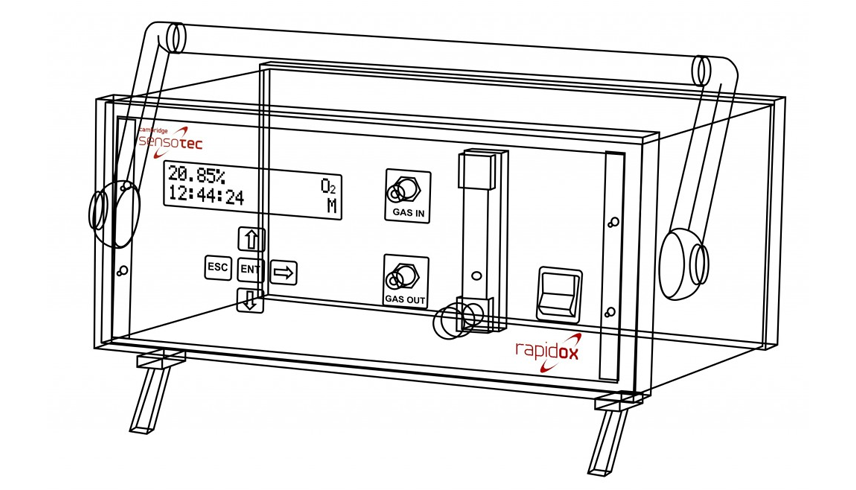
An industrial indoor air quality (IAQ) monitor is a specialised device designed to detect and measure harmful gases, particulates, and environmental conditions in demanding operational settings. Essentially, it acts as a smoke alarm for invisible threats. Unlike monitors for offices or homes, these robust systems provide the precise, reliable data needed to keep workers safe, maintain process integrity, and comply with strict UK health and safety regulations.
In an industrial plant, poor air quality is not just an inconvenience – it is a critical risk to safety, compliance, and productivity. Invisible hazards, from toxic gas leaks to fine particulate matter, can pose immediate dangers to your team and create long-term health problems. This guide offers a clear roadmap for plant managers, engineers, and safety officers tasked with choosing and implementing the right monitoring solutions.
We will demystify what these devices measure, break down the different sensor technologies behind them, and walk you through selecting the ideal system for your specific environment. Whether you are dealing with heat treatment, additive manufacturing, or electrical switchgear maintenance, we have you covered.
Effective air quality management is fundamental to any modern industrial operation. It is far more than a box-ticking compliance exercise; it is a strategic asset that underpins operational excellence. The benefits are clear and have a direct impact on both your bottom line and your team’s wellbeing.
Key advantages include:
The sharp focus on workplace safety is driving serious investment in monitoring technology. Here in the United Kingdom, the indoor air quality monitoring system market is seeing robust growth, fuelled by a greater awareness of the health risks posed by poor indoor environments.
The UK market is poised to surge towards £984.51 million by 2035, achieving a compound annual growth rate (CAGR) of 9.03% from 2025 to 2035. This impressive trajectory reflects just how seriously businesses are taking the link between suboptimal indoor air and respiratory disorders.
If you’re looking for a deeper dive into the systematic process of maintaining healthy indoor environments, this comprehensive indoor air monitoring guide is an excellent resource. It will help you turn what might seem like a regulatory burden into a powerful tool for operational excellence.
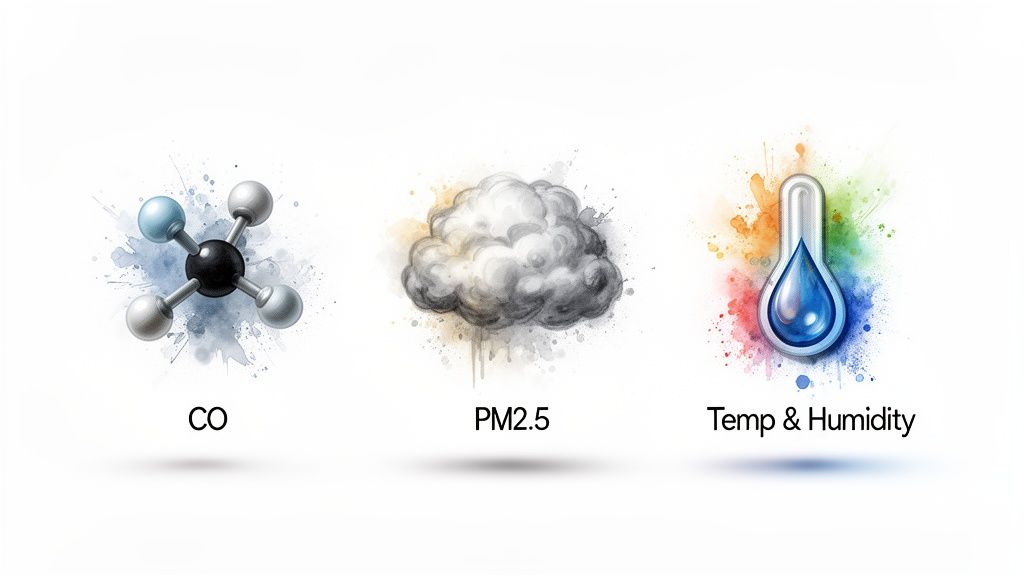
An indoor air quality monitor is your first line of defence against the invisible hazards lurking in your workplace. But what is it really looking for? Many people think a single device simply measures “air quality” as one overall score. The reality is far more sophisticated. These instruments are complex systems designed to detect and quantify specific threats, which fall neatly into three distinct categories.
Getting to grips with these measurement types is the first step in choosing a monitor that actually meets your site’s safety and operational needs. It is the difference between collecting random data and gathering actionable intelligence to protect your team and your processes.
The most critical job of any industrial monitor is sniffing out harmful gases that pose immediate or long-term health risks. These substances are often colourless and odourless, making reliable detection technology an absolute necessity for workplace safety.
The specific gases you need to watch for will depend entirely on your industrial processes.
An industrial indoor air quality monitor must be configured to target the precise gases present in your facility. A monitor designed for a welding shop will have a completely different sensor setup to one used in a chemical processing plant.
Beyond gases, the air in an industrial setting is often thick with tiny airborne particles. An indoor air quality monitor measures these particulates, sorting them by size. This is crucial because the smaller the particle, the deeper it can penetrate your body’s defences and the more dangerous it is.
Think of it this way: your body’s natural filters can trap larger dust particles, but the smallest ones can bypass these systems entirely, travelling deep into your lungs and even entering your bloodstream.
Monitoring both PM10 and PM2.5 gives you a complete picture of the airborne dust and fume hazards in your environment, allowing you to put effective control measures in place.
Finally, a truly comprehensive indoor air quality monitor also keeps track of key environmental parameters. These factors might not be direct contaminants, but they play a vital role in both workplace safety and process control. They can influence the concentration of other pollutants and even affect the performance of sensitive equipment.
Key environmental metrics include:
By monitoring these conditions alongside gases and particulates, you gain a complete understanding of your indoor environment. This holistic view enables you to maintain optimal conditions for safety, compliance, and operational efficiency.
The brain of any industrial indoor air quality monitor is its sensor array. It is the technology tucked away inside the casing that dictates everything—from accuracy and lifespan to whether it is even right for your application. To look past the marketing claims, it helps to have a grasp of how these sensors actually work. This lets you ask the right questions and choose a truly robust system.
At its core, a sensor is a device that reacts to a specific chemical or physical trigger, like a gas molecule or a dust particle, and turns that reaction into a measurable electrical signal. The sophistication of this process varies hugely between different sensor types, which is why matching the technology to the threat you’re monitoring is so critical.
When it comes to measuring Carbon Dioxide (CO2), Non-Dispersive Infrared (NDIR) sensors are widely seen as the gold standard for accuracy and longevity. You’ll find them in high-specification monitoring systems for a good reason.
Imagine a simple light beam shining from one end of a tube to a detector at the other. If you introduce CO2 into that tube, its molecules absorb some of the infrared light, effectively ‘blocking’ part of the beam. The NDIR sensor precisely measures how much light doesn’t make it to the detector. From that, it calculates the exact concentration of CO2 in the air. This method is highly specific to CO2 and isn’t prone to the measurement ‘drift’ that plagues less reliable sensor types.
For detecting specific toxic gases like Carbon Monoxide (CO) or hydrogen sulphide (H2S), electrochemical sensors are the go-to technology. These sensors operate a bit like tiny, gas-specific batteries, containing electrodes immersed in a chemical substance called an electrolyte.
When the target gas enters the sensor, it kicks off a chemical reaction on the electrode’s surface, generating a tiny electrical current. The strength of this current is directly proportional to the gas concentration. This makes them exceptionally sensitive and perfect for safety-critical applications where even low levels of a toxic gas pose a serious risk. To get a feel for different sensor principles, it’s useful to understand the difference between Zirconia and electrochemical oxygen gas sensors and how they apply in various industrial settings.
An electrochemical sensor is ‘tuned’ to react with only one specific gas. This prevents false alarms from other chemicals in the air, providing a highly reliable alert system for targeted threats.
This targeted precision is driving major investment in the sector. The Europe Indoor Air Quality Monitoring System Market, where the UK is a key player, is projected to hit USD 1.74 billion by 2033. This growth is particularly relevant for the UK’s industrial base, where fixed monitors are essential for meeting stringent workplace air standards that demand reliable sensor technology.
Beyond single-gas detection, other technologies give a wider view of airborne contaminants.
To get a better sense of how environmental measurements work, you might find it interesting to see how different temperature sensor types function in industrial settings. Knowing the difference between these core technologies ensures the indoor air quality monitor you choose has the right tools for the job.
Choosing an industrial indoor air quality monitor isn’t like picking a product off the shelf. When safety and process integrity are at stake, a generic, one-size-fits-all approach just will not cut it. Every industrial environment has its own unique atmospheric challenges, which means the right monitor must be perfectly matched to the specific risks and regulatory demands of your facility.
This selection process is far more than just ticking a compliance box. It’s about digging deeper than basic specifications to analyse the precise hazards your operations create. By aligning a monitor’s sensor capabilities with your exact needs, you ensure your investment delivers genuine safety and operational value.
In heat treatment and brazing, the main objective is controlling the furnace atmosphere to prevent oxidation and guarantee product quality. This usually means flooding the space with inert gases like nitrogen or argon to push out any oxygen. Because of this, the biggest risk is not a toxic substance, but a simple lack of oxygen.
An oxygen-deficient atmosphere can cause asphyxiation in seconds, often with no warning. That is why monitoring for depleted oxygen levels (O2) is absolutely critical in these areas.
The world of additive manufacturing, especially with polymers and resins, brings a whole different set of airborne hazards. As materials are melted or cured, they can release a complex cocktail of ultrafine particles (UFPs) and a wide range of Volatile Organic Compounds (VOCs).
These emissions are often invisible and odourless but can create serious long-term health risks. So, a suitable indoor air quality monitor needs to be equipped to sniff out both microscopic particles and chemical vapours.
In additive manufacturing, the danger is not a single gas but a cocktail of contaminants. A monitor with a combination of a Laser Particle Counter for UFPs and a Photoionisation Detector (PID) for total VOCs is often the most effective solution.
This visual decision tree helps simplify that first step of matching a hazard to the right sensor technology.
Specific threats like CO2, toxic gases, or VOCs each demand a distinct sensor type – NDIR, Electrochemical, or PID, respectively. It’s clear that no single sensor can do it all.
To help match your environment to the right monitoring technology, we’ve put together a quick reference table.
| Industrial Application | Primary Contaminants to Monitor | Key Monitor Features | Recommended Sensor Tech |
|---|---|---|---|
| Heat Treatment/Furnaces | Oxygen (O2) Depletion | Loud alarms, long sensor life, SIL2 rating option | Zirconia, Electrochemical |
| Additive Manufacturing | Volatile Organic Compounds (VOCs), Ultrafine Particles (UFPs) | Dual-sensor capability, wide detection range | PID, Laser Particle Counter |
| Research Labs/Cleanrooms | Trace Contaminants (VOCs, particulates) | High precision, low drift, robust data logging | PID, NDIR, high-sensitivity particle counters |
| Electrical Switchgear | Sulphur Hexafluoride (SF6) | High sensitivity for leak detection, specificity | NDIR tuned for SF6 |
This table serves as a starting point, highlighting how different industrial processes generate distinct atmospheric risks that require specialised monitoring solutions.
Precision is everything in a research lab. Here, the focus is not just on immediate safety threats but on ensuring environmental conditions don’t compromise experimental results. Contaminants at tiny, parts-per-billion concentrations can easily invalidate months of painstaking work.
Monitors for these environments demand high-precision sensors with excellent stability and minimal drift over time. Just as important is solid data logging, which allows researchers to connect any environmental fluctuations directly with their experimental outcomes.
High-voltage electrical switchgear often relies on Sulphur Hexafluoride (SF6) as an electrical insulator and to suppress arcs. While SF6 itself is non-toxic, it’s a powerful greenhouse gas and, like the inert gases in a furnace, it can displace oxygen in an enclosed space. A leak creates a serious asphyxiation hazard.
Detecting SF6 leaks is therefore a critical safety and environmental task. The monitor must have a sensor specifically designed to detect SF6, as a standard gas detector will not see it. The goal is to catch leaks early to protect staff and stop this environmentally damaging gas from escaping. This kind of specialised application is exactly why a detailed risk assessment is the essential first step in picking the right monitor for any job.
Purchasing an industrial indoor air quality monitor is just the first step. The real value of this equipment unfolds over its entire lifecycle, and that value hinges on two critical things: long-term accuracy and its ability to feed data into your operational systems.
Without these, even the most advanced monitor is little more than a box on the wall. Proper upkeep and smart data handling are what transform your monitor from a simple alarm into a powerful tool for process control and safety management. It’s how you get a complete, reliable view of your environment, moving beyond reactive alerts to proactive, data-driven decisions.
Think of a high-precision sensor like a finely tuned musical instrument. When it is new, it plays every note perfectly. But over time, constant exposure to temperature swings, humidity, and chemical contaminants can cause it to drift, delivering readings that are slightly off-key.
This gradual decline in accuracy is known as sensor drift. Regular calibration is simply the process of re-tuning the sensor against a certified reference gas or standard. This crucial maintenance step ensures the readings it provides are accurate and dependable. In a safety-critical industrial setting, skipping it just is not an option.
Neglecting calibration is like trusting a compass that does not point true north. The data becomes unreliable, creating a false sense of security and undermining the very purpose of monitoring your indoor air quality.
For any business that depends on precise measurements, a routine calibration schedule is essential for maintaining both compliance and safety. You can learn more about why calibration is key to ensuring your gas analysis equipment provides trustworthy results.
An indoor air quality monitor that operates in isolation provides limited value. The real power is unlocked when you integrate its data stream into your wider facility management and control systems. This is what turns raw numbers into actionable intelligence.
Modern industrial monitors offer a range of integration capabilities to make this happen:
The need for accurate, integrated data is clearly reflected in market trends. In the UK, the Air Quality Monitoring System Market was valued at USD 327.51 million and is forecasted to hit USD 812.74 million by 2033. This growth is not just a number; it is being driven by tougher health regulations and increasing operational demands.
For research institutes and system integrators, devices backed by robust calibration and training are essential for guaranteeing data integrity. This trend underscores a clear message: reliable data, guaranteed by proper calibration and seamless integration, is no longer a luxury but a fundamental requirement for modern industry.
Here in the UK, putting an industrial indoor air quality monitor to work is not just a smart move—it’s often a legal requirement. For many businesses, compliance is the number one reason for investing in monitoring, as it delivers the hard evidence needed to satisfy some pretty tough health and safety standards.
Getting to grips with these regulations is the key to justifying your investment, sidestepping hefty fines, and, most importantly, fulfilling your duty of care to your people. Think of these standards less as a burden and more as a blueprint for a safer, more productive operation. Continuous monitoring helps you shift from reacting to problems to proactively managing workplace safety before an incident ever occurs.
At the centre of UK workplace safety is the Control of Substances Hazardous to Health (COSHH) framework. In simple terms, these regulations legally bind employers to control substances that could harm health. This means you need to spot the hazards, assess the risks, and put effective controls in place to keep everyone safe.
An indoor air quality monitor is your most important tool in this process. It gives you the cold, hard data to prove your control measures are actually working. With continuous monitoring, you can clearly demonstrate due to diligence and show that you are actively managing the risks from airborne nasties, making it a cornerstone of your COSHH compliance strategy.
Under COSHH, it’s not enough to just install controls—you have to prove they’re still working day in, day out. An IAQ monitor is your constant watchdog, alerting you the second a control measure falters or a process tweak introduces a new risk.
To give COSHH some teeth, the Health and Safety Executive (HSE) sets legally binding Workplace Exposure Limits (WELs). These are the absolute maximum concentrations of a hazardous substance a worker can be exposed to, averaged over a specific time—usually 8 hours for long-term exposure or 15 minutes for short-term spikes.
Dipping below these limits is not optional; it is the law. The data from your indoor air quality monitor is your proof of compliance. It provides precise, time-stamped readings of contaminant levels, allowing you to confirm that exposures are staying safely within legal boundaries.
Without accurate monitoring, you’re flying blind. You have no way to prove you are protecting your team. Reliable data from a properly calibrated monitor is not just your best defence against non-compliance—it’s your best tool for guaranteeing a safe place to work.
Investing in an industrial indoor air quality monitor is a big decision. It is a core piece of your safety infrastructure, and getting the details right is crucial for protecting your team and your facility. Here are some of the most common questions we hear from industrial buyers, with clear, straightforward answers.
Making a well-informed choice moves you beyond simple compliance. It turns your monitoring system into a valuable asset for operational safety and day-to-day efficiency.
This really depends on the sensor technology, the manufacturer’s guidelines, and just how critical the application is. For safety systems designed to prevent immediate harm—think toxic gas alarms or oxygen depletion sensors—we typically recommend calibration every 6 to 12 months.
However, some sensors need more frequent checks, especially if the monitor is working in a particularly harsh or dusty environment. You should always treat the manufacturer’s schedule as the bare minimum. At the end of the day, consistent calibration is the only way to be certain your data is accurate, reliable, and legally defensible if an incident occurs.
The main difference comes down to their intended purpose and how they are used on-site.
Most industrial facilities end up using a combination of both. Fixed systems provide constant protection for known high-risk zones, while portable units are brought in for versatile, on-the-spot investigations.
No, a single indoor air quality monitor simply cannot detect everything. While advanced multi-gas analysers are incredibly capable, they have to be fitted with the right sensors for the specific hazards present in your workplace.
For example, a monitor set up to detect CO₂ and O₂ will be completely blind to Volatile Organic Compounds (VOCs) unless it is also equipped with a Photoionisation Detector (PID) sensor. In the same way, it will not measure airborne dust without a laser particle counter.
A comprehensive risk assessment of your site should always be the first step. This process is essential for identifying the precise contaminants you’re dealing with, ensuring you select a monitor with the right combination of sensors to properly protect your team and your operations.
At Cambridge Sensotec, we specialise in delivering precision gas analysis solutions for demanding industrial applications. Our experts are here to help you navigate the complexities of sensor selection, calibration, and data integration to ensure your facility is safe, compliant, and efficient. Explore our range of Rapidox gas analysers and find the right solution for your needs at https://cambridge-sensotec.co.uk.
Please leave your email address below and we'll reach out promptly.