
How to Choose the Right Gas Analyser for Your Industry
Read More
A hydrogen gas tester is, at its core, a specialised instrument built to do one thing exceptionally well: detect and measure the concentration of hydrogen (H₂) gas in a particular environment. You can think of it as a highly advanced smoke alarm, but for an invisible, odourless and extremely flammable gas.
Its primary function is to convert the presence of hydrogen into a clear, readable electronic signal. This simple task is absolutely vital for both preventing catastrophic explosions and guaranteeing quality in a huge range of sensitive industrial processes.
The main role of a hydrogen tester is to keep a constant, reliable watch over atmospheric conditions. It is designed to alert operators long before hydrogen concentrations ever approach dangerous levels, giving them the crucial time needed to act.
Hydrogen is a cornerstone of modern industry, but it comes with serious risks. It is incredibly flammable, with a wide explosive range in air (from 4% to 75%), and it takes very little energy to ignite. A simple spark from static electricity could be enough to cause a disaster. This is why precise, real-time monitoring is non-negotiable anywhere hydrogen is produced, stored, or used.
A hydrogen gas tester’s importance goes well beyond just safety. While preventing explosions is its most critical function, it also plays a massive part in process control and quality assurance. In many industrial settings, the exact concentration of hydrogen has a direct impact on the quality of the final product.
Take metallurgical heat treatment, for example. Achieving specific hydrogen levels inside a furnace atmosphere is essential for strengthening metals and preventing oxidation. Too little or too much H₂ can completely compromise the structural integrity of a component. A hydrogen gas tester ensures the atmospheric recipe is perfect every single time.
To put it simply, these devices fulfil several critical functions in any industrial setting where hydrogen is present.
| Function | Why It Is Important | Example Application |
|---|---|---|
| Leak Detection | Prevents the build-up of flammable gas concentrations, protecting personnel and facilities from explosion risks. | Continuously monitoring pipe fittings and seals in a hydrogen storage facility. |
| Process Control | Ensures the precise gas mixture required for a specific industrial process, guaranteeing product quality and consistency. | Maintaining the ideal H₂/N₂ ratio in a furnace for metal sintering. |
| Quality Assurance | Verifies the purity of hydrogen gas streams or confirms the absence of H₂ where it would be a contaminant. | Checking the final purity of hydrogen produced via electrolysis. |
| Safety Monitoring | Provides early warnings in enclosed spaces where hydrogen could accumulate and displace oxygen, posing an asphyxiation risk. | Monitoring the atmosphere inside a power plant’s generator cooling system. |
By constantly monitoring for leaks and ensuring precise concentrations are maintained, a hydrogen gas tester is fundamental to operational excellence.
A hydrogen gas tester protects personnel, prevents equipment damage, and guarantees that industrial processes meet the most stringent quality standards.
Beyond its flammability, hydrogen creates other challenges that a reliable tester helps to manage. One of the most significant is hydrogen embrittlement. This is a phenomenon where hydrogen atoms seep into metals like steel, making them brittle and highly susceptible to cracking under stress. This can lead to the catastrophic failure of pipelines, storage tanks, and other critical infrastructure.
Ultimately, a hydrogen gas tester provides the critical data needed to operate safely and efficiently. It transforms an invisible threat into a manageable variable, safeguarding both people and processes. For a deeper look into this topic, you can explore our detailed guide on why hydrogen measurement is critical in today’s industrial settings. This understanding is the first step toward selecting and using these vital instruments effectively.
To pick the right hydrogen gas tester, you first need to know what’s going on under the bonnet. At the core of every analyser is a sensor, the component that does the actual work of detecting and measuring hydrogen. In the industrial world, two main technologies lead the pack: Thermal Conductivity Detectors (TCD) and Electrochemical sensors.
Each technology operates on a completely different principle, which makes them suited for different jobs, environments, and measurement ranges. Think of it like choosing between a high-precision scale and a tape measure; both are measurement tools, but you wouldn’t use one for the other’s task. Getting to grips with how each sensor works is the first step toward making a smart choice for your specific application.
A Thermal Conductivity Detector, or TCD, is one of the most reliable and long-lasting sensor types you can get. Its operation is surprisingly simple and can be understood with a basic analogy: imagine a tiny, heated wire sitting in a constant breeze.
The wire is kept at a perfectly steady temperature. When a gas flows over it, that gas carries heat away, cooling the wire down slightly. The amount of energy needed to reheat the wire back to its original temperature is then measured.
Now, different gases have different abilities to conduct heat away. Hydrogen is exceptionally good at this—far better than common gases like nitrogen or argon. It acts like a very cold, fast wind, cooling the wire much more effectively than anything else.
A TCD sensor in a hydrogen gas tester uses this exact principle, comparing the cooling effect of your sample gas to that of a known reference gas.
This method is purely physical, which means the sensor doesn’t undergo chemical changes during measurement. As a result, TCD sensors have an exceptionally long lifespan and are not consumed or depleted over time, making them a fantastic, cost-effective choice for continuous process monitoring.
A Thermal Conductivity Detector essentially measures how quickly a gas can ‘steal’ heat from a heated element. Hydrogen is an expert thief, making it easy for the sensor to spot and quantify.
Electrochemical sensors work in a completely different way. The easiest way to think of them is as tiny, specialised batteries that only generate power when a specific gas—in this case, hydrogen—is present.
These sensors contain electrodes and an electrolyte solution. When hydrogen gas enters the sensor and makes contact with the sensing electrode, a chemical reaction (oxidation) takes place.
This reaction generates a tiny electrical current. The strength of this current is directly proportional to the concentration of hydrogen gas present. The analyser’s electronics then measure this current and translate it into a readable concentration, usually in Parts Per Million (PPM).
Because they are designed to react with a specific chemical, electrochemical sensors are brilliant for detecting very low concentrations of hydrogen. This makes them the go-to choice for safety applications where even a tiny leak needs to be flagged immediately. For a more technical overview, our guide on hydrogen gas measurement techniques offers additional insights into how these sensors are applied in the field.
Choosing between a TCD and an electrochemical sensor comes down entirely to what you need to do. Neither is universally “better”; they are simply designed for different jobs. One is a marathon runner, built for endurance and high-level performance, while the other is a sprinter, excelling at rapid detection of small amounts.
| Feature | Thermal Conductivity (TCD) Sensor | Electrochemical Sensor |
|---|---|---|
| Measurement Range | High concentrations (e.g., 1% to 100%) | Low concentrations (e.g., 0-2000 PPM) |
| Primary Use Case | Process control, purity analysis, furnace atmospheres | Safety monitoring, leak detection, personnel safety |
| Lifespan | Very long (often years), not consumed by measurement | Finite (typically 1-3 years), consumed over time |
| Sensitivity | Excellent for %-level analysis | Excellent for PPM-level trace analysis |
| Response Time | Fast | Very fast |
| Oxygen Requirement | Does not require oxygen to operate | Requires some oxygen for the chemical reaction |
Ultimately, if your goal is to precisely control a high-purity hydrogen atmosphere in an industrial furnace, a TCD-based hydrogen gas tester is the correct tool. But if you need to protect a workspace by detecting small, potentially explosive leaks, an electrochemical sensor is the far more appropriate and effective choice.
Picking the right sensor technology is a massive first step, but just as important is choosing the right physical format for your hydrogen gas tester. The analyser’s design dictates exactly how and where you can use it, which has a direct impact on your daily workflow, efficiency, and safety.
The three main formats—Portable, Benchtop, and OEM—are each built for very different jobs and environments.
Think of it like picking a vehicle. You wouldn’t take an articulated lorry on a quick trip to the shops, and you wouldn’t try to haul heavy cargo in a small city car. Each is perfect for its intended purpose. In the same way, matching the analyser’s format to your specific task ensures you’ve got the most effective and practical tool for the job.
Portable hydrogen gas testers are the versatile, on-the-go experts. Designed for total mobility, these handheld or easily carried units are absolutely essential for engineers and technicians who need to take measurements in multiple locations, often in tricky field conditions. They are your first line of defence for spot-checks, diagnostics, and leak detection.
Their real strength is their flexibility. A technician can grab a portable analyser to check for hydrogen leaks around electrical switchgear, verify atmospheric conditions before starting maintenance in a confined space, or troubleshoot a process line right on the factory floor. They are built for getting to work fast and delivering immediate results, giving you critical data exactly where you need it.
For instance, a robust device like a portable multigas analyser allows maintenance teams to quickly confirm gas compositions without being tied to one spot. This freedom of movement is vital for proactive safety sweeps and solving problems efficiently.
While portable units are the champions of the field, benchtop analysers are the established experts of the laboratory and control room. These are larger, stationary units designed for high-precision, continuous monitoring where stability and advanced data-logging are everything. They essentially act as the central nervous system for your quality control and process optimisation.
Benchtop models often come equipped with more sophisticated sensors, larger displays, and extensive connectivity options, allowing them to integrate smoothly with other lab equipment or factory control systems. They are the workhorses for applications that demand unwavering accuracy over long periods.
In a research lab developing new materials or a heat treatment facility perfecting a furnace atmosphere, a benchtop hydrogen gas tester provides the reliable, minute-by-minute data needed to ensure processes remain within tight specifications.
This infographic gives a simple visual breakdown of the core principles behind the main sensor technologies used in these devices.
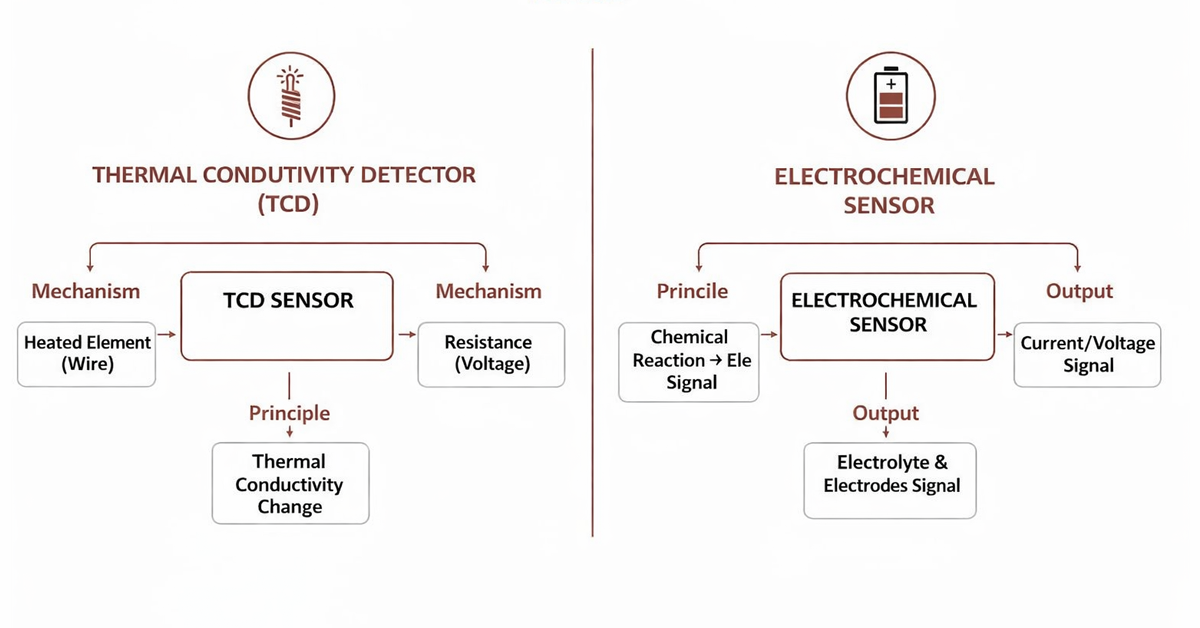
As the diagram shows, there’s a clear difference between the physics-based principle of Thermal Conductivity Detectors (TCD) and the chemical reaction that drives Electrochemical sensors.
OEM (Original Equipment Manufacturer) solutions are the most specialised format of all. These are not standalone devices; they are component analysers designed to be built directly into larger pieces of machinery or integrated into a complete system. They become the “integrated brains” that provide hydrogen monitoring as a core feature of another product.
For example, a manufacturer of industrial furnaces might incorporate an OEM hydrogen gas tester directly into their control panel. This gives their customers built-in, real-time atmospheric monitoring without needing a separate analyser. This deep integration allows for automated process control, where the machinery can adjust itself based on the gas readings.
Fixed hydrogen detection systems, which often rely on OEM components, are becoming more and more vital. These stationary analysers are gaining serious market traction, holding 46.5% of the global hydrogen detection share, and are particularly relevant in the UK’s growing renewable energy and manufacturing sectors. They are specifically tailored for continuous monitoring in high-risk areas like electrolyser halls and compressor buildings, integrating with plant-wide safety systems—a compliance mandate in many UK industrial environments.
Stepping into the world of industrial gas analysis means coming face-to-face with technical data sheets. At first glance, these documents can seem dense with jargon and numbers, but they hold the key to choosing the perfect hydrogen gas tester for your exact needs.
Think of a data sheet not as a complex manual, but as the DNA of the analyser. It tells you what the instrument can do, how well it does it, and where it will perform best. Understanding these specs is less about memorising definitions and more about translating them into what they mean for your day-to-day operations.
Let’s break down the most important metrics you’ll encounter.
The measurement range is the first thing you should check. It tells you the span of concentrations the analyser can detect, from its lowest limit to its highest. This isn’t just a set of numbers; it defines the exact job the analyser is built for.
You’ll usually see ranges expressed in either Parts Per Million (PPM) or Percent (%) Volume.
Choosing the right range is critical. Using a % volume analyser to find a tiny leak would be like trying to measure a single grain of sand with a bathroom scale—the tool is simply not sensitive enough for the task.
To cut through the complexity of a data sheet, it helps to frame each specification as a practical question. This table breaks down the key specs and what you should be asking to ensure an analyser truly fits your needs.
| Specification | What It Means in Practice | Key Question to Ask |
|---|---|---|
| Measurement Range | The span of gas concentrations the analyser can detect (PPM for trace, % for bulk). | Does the range cover both my normal operating levels and any potential leak scenarios? |
| Accuracy | How close the reading is to the true gas concentration. | Is the stated accuracy (e.g., ±1% of full scale) sufficient for my process control or safety limits? |
| Resolution | The smallest change in concentration the analyser can display (e.g., 0.1% or 1 PPM). | Is the resolution fine enough to see the small fluctuations that matter to my process? |
| Response Time (T90) | How quickly the sensor reacts to a change in gas levels. | Is the T90 fast enough (e.g., <30 seconds) for my safety alarms to be effective? |
| Cross-Sensitivity | How the sensor might react to other gases in the environment, causing false readings. | What other gases are present, and has the sensor been tested to ensure it will not react to them? |
Ultimately, a good supplier should be able to walk you through these questions and explain how their equipment meets your specific operational and safety requirements.
The terms ‘accuracy’ and ‘resolution’ often get mixed up, but a simple analogy with a ruler makes their distinct roles clear. Imagine you are measuring a small component that is exactly 10.5mm long.
Accuracy is how close your measurement comes to the true value. If your ruler consistently measures the component as 10.5mm, it is accurate. If it reads 11mm every time, it is inaccurate.
Resolution is the smallest increment you can see on your ruler. A ruler marked only in whole centimetres has a resolution of 1cm, while one marked in millimetres has a much finer resolution of 1mm.
In a hydrogen gas tester, accuracy might be stated as ±1% of the full scale. For a 0-100% range, this means the reading is guaranteed to be within 1% of the true value. Resolution, on the other hand, is the smallest change the display can show, such as 0.1% or 1 PPM. You need both for reliable results.
Response time, often listed as T90, is a direct measure of how quickly the sensor reacts when gas concentration changes. The T90 value tells you the time it takes for the analyser to display 90% of the final, stable reading after being exposed to the gas.
A faster response time is absolutely critical for safety. If a hydrogen leak occurs, you need an alarm to trigger almost instantly. A T90 of less than 30 seconds ensures that personnel are alerted promptly, giving them vital time to evacuate or take corrective action. For a full breakdown of risks, always consult the official Safety Data Sheet for hydrogen gas.
Finally, cross-sensitivity is one of the most important but often overlooked specifications. It describes how the sensor might react to gases other than the one it’s meant to measure. A sensor might, for instance, show a false positive for hydrogen when exposed to another gas with similar chemical properties.
This is a common challenge in industrial settings where mixed-gas environments are the norm. Choosing a hydrogen gas tester with low cross-sensitivity to the other gases in your process is essential for getting trustworthy readings you can actually rely on.
It is a challenge seen across industries requiring precise gas monitoring. For instance, the UK hydrogen fluoride gas detection market, which shares similar safety needs, is projected to grow at a CAGR of 4.9% through 2035. This growth highlights the rising demand for precise analysers in applications like green hydrogen production, where purity is key, and heat treatment, where real-time monitoring is vital as hydrogen becomes flammable above 4% vol.
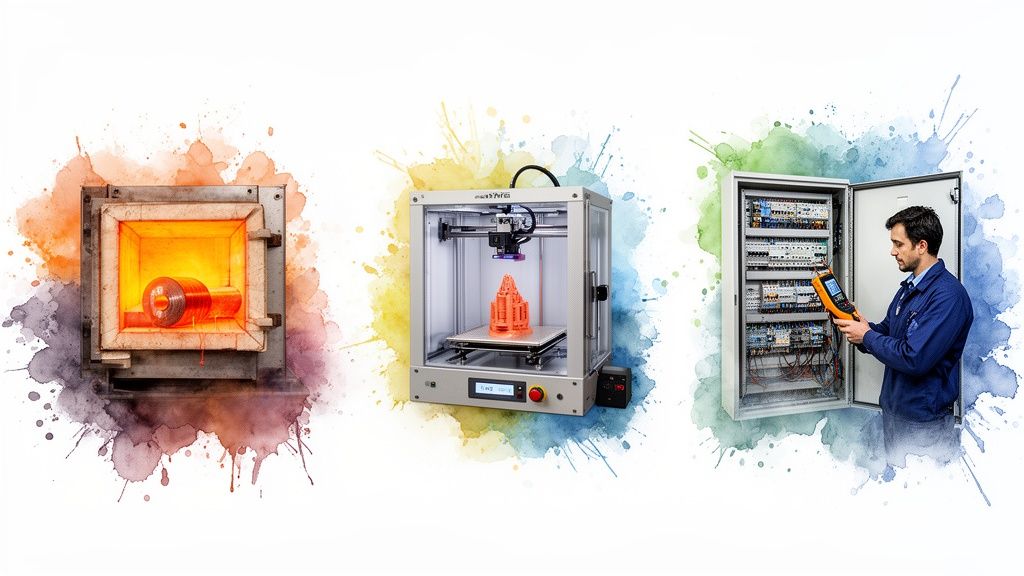
Understanding the technical specs of a hydrogen gas tester is one thing, but seeing it in action is where you grasp its real value. These instruments are not just abstract tools; they are vital components in some of today’s most advanced and demanding industrial processes. From strengthening metals to building intricate parts layer by layer, the right analyser has a direct impact on operational success, safety, and product quality.
Let’s move from theory into the practical world of modern manufacturing and energy, exploring four key areas where these testers are absolutely indispensable.
In the world of metallurgy, the atmosphere inside a furnace is everything. Heat treatment processes like annealing and sintering depend on a meticulously controlled environment to alter the physical properties of metals, making them stronger and more durable. Hydrogen is a key ingredient in these atmospheric recipes.
Imagine an industrial furnace treating critical aerospace components. A hydrogen gas tester is on the job, continuously monitoring the H₂ concentration to ensure it stays at the precise level needed to prevent oxidation and achieve the desired metallurgical properties. If that concentration wavers, the final product could end up brittle or weak, leading to costly and dangerous failures down the line.
In essence, the analyser acts as the furnace’s guardian, guaranteeing a perfect, repeatable atmosphere for every single batch.
Additive manufacturing, or 3D printing with metal powders, is another field where atmospheric integrity is non-negotiable. Inside the build chamber of a selective laser melting (SLM) machine, a high-energy laser fuses fine metal powders together, layer by painstaking layer.
During this intricate process, any residual oxygen or moisture can cause defects like porosity, which severely compromises the structural integrity of the final part. To stop this from happening, the chamber is flooded with an inert gas like argon, but hydrogen levels must also be closely monitored. A hydrogen gas tester ensures the build atmosphere remains pure, guaranteeing the finished component has the exact material properties it was designed for.
High-voltage switchgear, a cornerstone of our electrical grid, often uses a mix of hydrogen and nitrogen as a coolant. Over time, tiny leaks can develop in seals and fittings, allowing this crucial gas mixture to escape. An undetected leak is not just inefficient; it can lead to overheating and, ultimately, catastrophic equipment failure.
This is where a portable hydrogen gas tester becomes an essential maintenance tool. Because hydrogen is the lightest element, it rises quickly, making it a brilliant tracer gas. Maintenance teams use the analyser to scan joints and seals, pinpointing the exact location of even the smallest leaks so they can be repaired swiftly and safely.
As the hydrogen economy gathers pace, so does the need to verify the purity of the gas being produced, whether it’s green hydrogen from electrolysis or blue hydrogen from steam methane reforming. A hydrogen gas tester is crucial for quality control at production facilities, confirming that the final product meets stringent purity standards (e.g., 99.999%) before it is stored or transported.
Safety monitoring is just as important. The United Kingdom’s gas leak detector market, which includes hydrogen testers, is set to grow from USD 4.77 billion in 2025 to USD 6.85 billion by 2032, a jump driven by tightening safety rules and the expanding hydrogen sector. For instance, in applications that require entering potentially hazardous environments, understanding protocols like those in an essential safety guide for confined spaces is critical for deploying gas testers correctly and safely.
A hydrogen gas tester is only ever as good as its last calibration. Over time, even the most robust sensors are prone to ‘drift’, where readings gradually become less accurate. This is a natural process, influenced by everything from temperature shifts and humidity to tiny trace contaminants in the environment. The only way to counteract this and keep your data trustworthy is through regular, proactive maintenance.
Think of it like tuning a musical instrument. The process does not change the instrument itself, but it carefully adjusts it back to a known, correct standard. For a gas analyser, this means exposing the sensor to a certified gas with a known hydrogen concentration and tweaking the instrument’s response until it matches that standard perfectly.
This scheduled upkeep is not just about ticking a box for compliance standards like ISO 9001. It’s about safeguarding your processes, your products, and your people by making sure every single measurement is accurate and dependable.
When it comes to keeping your hydrogen analyser in top shape, you have really got two main routes. Each has its place, and the right choice depends on your team’s skills, the complexity of your equipment, and your own internal quality rules.
The first option is to handle calibration in-house. This usually involves connecting a cylinder of certified calibration gas and following the manufacturer’s steps to reset the sensor’s zero point (with a zero-gas like nitrogen) and its span (using the known hydrogen concentration).
While self-calibration is brilliant for regular upkeep, a professional service is like a complete health check for your instrument. It guarantees long-term performance and ultimately extends its working life.
A consistent maintenance schedule is the best investment you can make in your equipment. It turns your hydrogen gas tester from a simple tool into a reliable partner you can count on, day in and day out, giving you complete confidence in the data it provides.
Even with a good grasp of the technology and applications, a few practical questions often come up. We get asked these all the time, so let us clear up some common queries to help you feel confident in your decision.
There’s no single answer here—it really depends on what you are using it for. For critical safety monitoring or high-purity industrial processes where precision is paramount, we strongly recommend a calibration every 6 to 12 months. This regular check-up ensures your readings are always accurate and dependable.
For less intensive applications, an annual calibration might be all you need. The best rule of thumb is to follow the manufacturer’s guidance. However, if your hydrogen gas tester is working in a tough environment or is regularly exposed to contaminants, calibrating it more frequently is a smart move. Think of it as an investment in its long-term accuracy.
Absolutely. Many modern analysers are built for exactly that. It is common for advanced systems to be configured to monitor hydrogen alongside other important gases like oxygen (O₂) or moisture (H₂O).
This multi-gas capability is a game-changer in complex industrial settings. For instance:
A multi-gas hydrogen gas tester tidies up your monitoring setup, consolidating everything into one efficient instrument.
Being able to measure multiple gases with a single device simplifies your workflow, cuts down on equipment clutter, and gives you a much clearer picture of your process. This all-in-one approach is a key feature in many of today’s best analysers.
Both PPM and percent (%) volume measure gas concentration, but they are used on completely different scales for very different jobs. It’s a bit like using a jeweller’s scale versus a lorry weighbridge.
Parts Per Million (PPM) is your high-precision tool for detecting tiny, trace amounts of gas. This is vital for safety and leak detection. A small PPM reading can alert you to a serious problem long before hydrogen reaches dangerous, explosive levels.
Percent (%) Volume, on the other hand, is for measuring high concentrations. This is the standard in process control, where hydrogen is a major, deliberate part of the gas mix. A hydrogen gas tester measuring in % volume makes sure the recipe in your furnace or reactor is spot on.
At Cambridge Sensotec, we live and breathe gas analysis. Our team has years of experience helping customers find robust and reliable solutions that fit their industry’s unique needs. We are here to help you choose the right hydrogen gas tester to improve your safety, quality, and efficiency. Explore our range of analysers and find your solution at https://cambridge-sensotec.co.uk.
Please leave your email address below and we'll reach out promptly.